
PHASE ARRAYS and SUB-SYSTEMS
PHASE ARRAYS and SUB-SYSTEMS
Phased array antennas have become a foundational technology across modern communication and defense systems, enabling electronic control of a beam’s direction without any mechanical movement. By precisely adjusting the phase, and often the amplitude, of the signal at each individual radiating element, a phased array can steer, shape, and even split its beam electronically, achieving scan speeds and pointing accuracy far beyond what mechanically steered antennas can offer. This capability underpins a wide range of applications: in defense, phased arrays power radar systems for surveillance, tracking, and missile guidance, where rapid, agile beam steering is critical to detecting and responding to fast-moving threats. In communications, they enable high-throughput satellite links, 5G base stations, and point-to-point wireless systems that must maintain reliable connections with moving platforms or serve multiple users simultaneously. As systems increasingly demand smaller form factors, lower power consumption, and higher channel counts, electronically scanned arrays, particularly active electronically scanned arrays (AESA), have emerged as the technology of choice for next-generation aerospace, defense, and communications platforms.
These systems are typically implemented in one of two array configurations, tile or brick format, each offering distinct trade-offs in size, power handling, and thermal performance.
TILE ARRAY CONFIGURATION
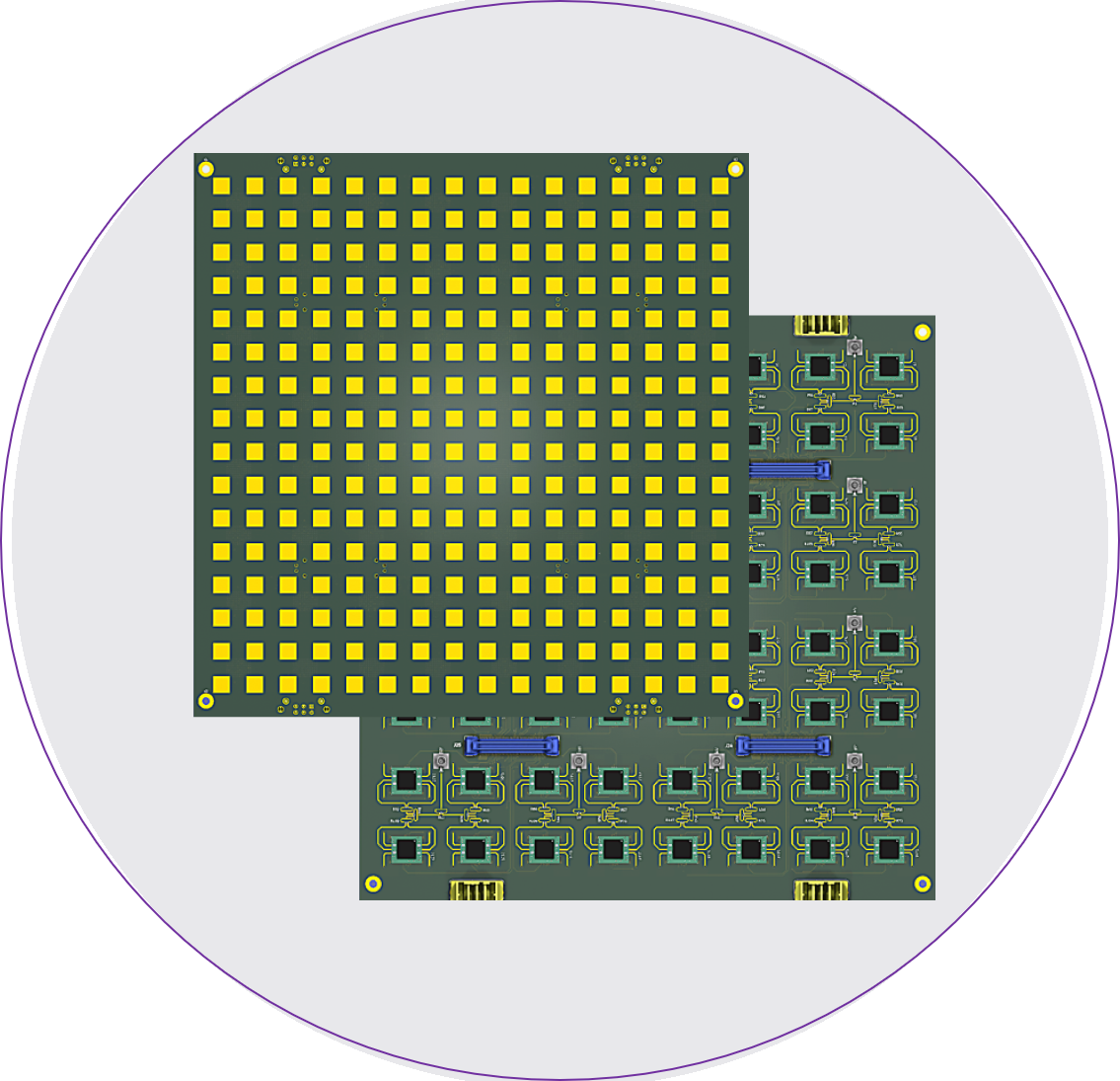
RIO SYSTEMS‘ tile-array architecture integrates the RF front end, beamforming electronics, and radiating elements into a single, low-profile, planar assembly. Each tile combines the antenna elements, beamforming ICs, DC/RF distribution, and often digital control on a common multilayer board, allowing the array to be built up as a mosaic of identical, independently testable and replaceable tiles. This approach reduces overall system height and weight while managing thermal dissipation by spreading heat-generating components across a wide, flat surface. The tile architecture also enables scalable, modular apertures, where array size can be adjusted by adding or removing tiles without redesigning the underlying system. For aerospace, defense, and communications platforms where size, weight, and conformal mounting are critical constraints, tile-based AESA designs offer an efficient path to high-channel-count, electronically scanned apertures.
To meet the tight size constraints of tile-array architecture, RIO SYSTEMS invests heavily in system-in-package (SiP) design and integration, consolidating multiple active components, such as beamforming ICs and RF front-end circuitry, into a single, highly compact package. By leveraging advanced packaging techniques and vertical integration across semiconductor and system design, the company reduces the footprint and height of each channel’s active electronics, enabling more elements to be packed within the limited real estate of a tile without compromising thermal or electrical performance. This SiP-driven miniaturization is central to achieving the low-profile, high-density apertures that tile-based AESA systems demand.
BRICK ARRAY CONFIGURATION
RIO SYSTEMS also offers brick-array architecture for AESA systems, where transmit/receive modules are mounted perpendicular to the radiating aperture rather than integrated into a flat, planar tile. This vertical arrangement gives each channel significantly more volume for RF components, power amplifiers, and heat sinking, making brick architecture well suited to applications demanding higher transmit power, wider bandwidth, or more complex per-channel signal processing than a tile can accommodate. The added depth also simplifies liquid or conduction cooling paths, since heat-generating components can be mounted directly against a structural cold plate running the length of the module. While brick arrays are typically heavier and less conformal than tile-based designs, they remain the preferred approach for high-power aerospace and defense radar and communications systems, where per-channel performance and thermal headroom outweigh the benefits of a low-profile form factor.
For further details regarding phase‑array technologies, system-in-package and subsystem solutions, direct your inquiries to info@rio-system.com.